 tattletag
AI-generated
Made by AI with little or no human editing. The most direct label there is.
Pick this level when
- The text, image, audio or code came from an AI tool and went out mostly as it was.
- Bulk content such as product descriptions or summaries published without a line-by-line check.
- Art and experiments where the AI output is the point.
Pick another level when
- A person checked and fixed it: AI-made, human-checked.
- A person did the main work: AI-assisted.
Every badge at this level



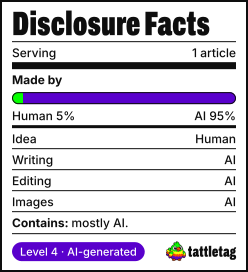
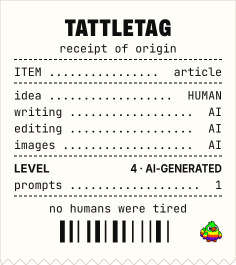
Generated with AI. Disclosure by Tattletag
Saying it plainly
An AI-generated label tells readers what they are looking at, and it protects you: nobody can say you passed machine work off as your own. The funny versions ("All AI, zero shame") make the same point with a grin.
When the law asks for it
Since 2 August 2026, article 50 of the EU AI Act asks deployers to disclose deepfakes (images, audio or video that look real and were made or changed by AI) and AI-generated text published to inform the public on matters of public interest. Fines go up to €15 million or 3% of worldwide turnover. The label must be clear at first sight; for deepfakes, the Commission's Code of Practice puts it on the content itself. The EU's own AI icons ("AI + GENERATED") are free to use and a Tattletag badge can sit beside them. A badge alone does not make you compliant.
Make your own
Who did what
The image loads from aidisclosurebadge.com. Paste the code where you want the badge: an HTML block, a theme footer or a README.
Every badge links to the page explaining its level, in the badge's language.
Questions
Do I need the official EU icon?
The EU icons are optional; the duty to disclose is not. You can use the EU icon, an equivalent label, or both.
Does an AI-generated label hurt my SEO?
Google says it ranks content on quality and helpfulness, no matter how it was made. A label tells readers the truth; it does not tell search engines anything new.
The four levels
No AI touched the words, images, sound or code.
Badges and meaning →Level 2AI-assistedA person made it. AI helped with research, editing, translation or ideas.
Badges and meaning →Level 3AI-made, human-checkedAI produced most of it. A person checked it, fixed it and stands behind it.
Badges and meaning →Level 4AI-generatedMade by AI with little or no human editing.
Badges and meaning →