 tattletag
Say who made it.
Free AI disclosure badges for blogs, portfolios, newsletters and shops. Pick one of four levels, pick a format, paste the code. No sign-up and no script on your site.
Who did what
The image loads from aidisclosurebadge.com. Paste the code where you want the badge: an HTML block, a theme footer or a README.
Every badge links to the page explaining its level, in the badge's language.
Four levels, four colours
Green means no AI, violet means AI made it. The two levels in between cover what most people really do: a person in charge with AI helping, or AI doing the work with a person checking it. Readers learn the colours fast.
No AI touched the words, images, sound or code.
Badges and meaning →Level 2AI-assistedA person made it. AI helped with research, editing, translation or ideas.
Badges and meaning →Level 3AI-made, human-checkedAI produced most of it. A person checked it, fixed it and stands behind it.
Badges and meaning →Level 4AI-generatedMade by AI with little or no human editing.
Badges and meaning →Six formats
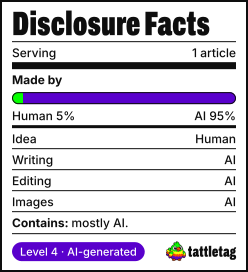
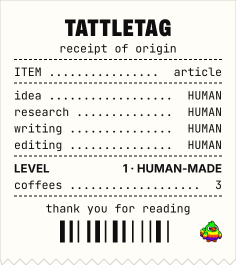
The pill fits next to a byline or in a README. The 88×31 button is the small-web classic for blogrolls and personal sites. The stamp closes an article or a portfolio page. The Disclosure Facts label works like a nutrition label: who did the idea, research, writing, editing and images, with the human share as a bar. The receipt itemises the same thing with a wink. The footer line is plain text for sites that want no image at all.

Funny ones, still honest
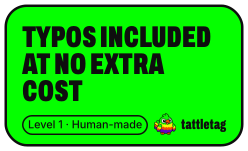
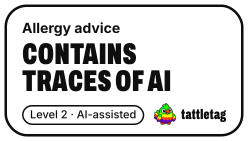
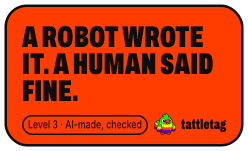
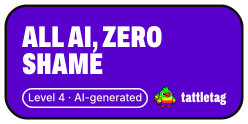
Some people only put up a badge with a grin. Every funny sticker still names its real level in the corner, so "Beep boop. A machine wrote this." is a joke and a correct disclosure at the same time. There is a slop corner too, because people make slop as well.
What a badge does, and what it does not
A badge tells your readers how a piece was made, in one glance. That is good manners, and since 2 August 2026 parts of it are law in the EU: article 50 of the AI Act asks deployers to disclose deepfakes and AI-written text on matters of public interest.
A badge on its own does not make you compliant with any law. If a rule applies to you, follow it where it says the label must go (for EU deepfakes: on the image or video itself, visible at first sight). The EU publishes its own AI icons, free for anyone to use. Tattletag badges can sit next to them.
Each badge links to a page that explains its level, so a reader who wonders what "AI-assisted" means gets an answer in their own language.
Questions
Is it free?
Yes. Every badge, every format and the statement generator are free, also for business use. Keep the link on the badge; that is the only thing we ask.
Does the badge track my readers?
No. The badge is a plain image inside a plain link. It loads no script and sets no cookie, so you need no cookie banner for it.
Which level should I pick?
Ask who did the main work. If a person did and AI only helped (spelling, research, translation, ideas), pick AI-assisted. If AI produced most of it and a person checked it, pick AI-made, human-checked. The levels page walks through examples.
Does a badge make me compliant with the EU AI Act?
No badge does that by itself. The AI Act says what must be disclosed and where; a badge is one way to show it. Read the article 50 guide to see if the rules apply to you.
Can I change the colours?
The four level colours stay as they are, so readers can learn them. You can pick a version for light or dark sites, an outline version, and a small or large size.