tattletag
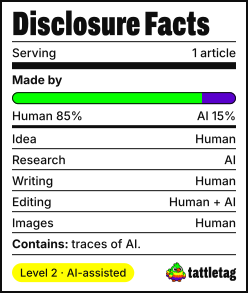
To label AI-written blog posts honestly, readers need three things: a short label at the top that names how much AI did, one line at the end that says what it did, and a page on your blog that explains what your labels mean. All three take five minutes. The hard part is picking the right level, so start there.
Which label fits your blog post?
Tattletag sorts every post into four levels. Pick the one that matches who wrote the words readers see.




| How the post was made | Level | Label at the top |
|---|---|---|
| You wrote every word; a spellchecker fixed typos | Human-made | Human-made |
| You wrote it; AI suggested headlines, found sources or tightened sentences | AI-assisted | AI-assisted |
| You wrote it in your language and AI translated it | AI-assisted | AI-assisted (translated with AI) |
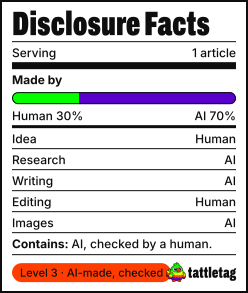
| AI wrote the draft; you checked facts, rewrote parts and signed off | AI-made, human-checked | AI-made, human-checked |
| AI wrote it and nobody edited it before it went live | AI-generated | AI-generated |
| You wrote the text; the header image comes from an image model | AI-assisted for the post, plus a caption on the image | AI-assisted, and “Image: made with AI” under the picture |
The test is simple: whose sentences are on the page? If they are yours, the post is human-made or AI-assisted. If they started as AI output, the post is level 3 or 4, and the difference between the two is whether a person checked it before publishing.
Where does the label go on a blog post?
Put it where readers look before they read:
- At the top, next to the byline, date or reading time. A small pill badge fits on the same line.
- At the end, one sentence that says what AI did: “Written by me, with AI help for research and editing.”
- On an AI policy page (an “About” section works too) that explains your four levels. Link both labels to it, or to the Tattletag level page, which does the explaining for you.
Medium’s own rule points the same way. Its AI content policy (checked November 2026) asks writers to label any story with AI assistance and says a simple sentence “within the first two paragraphs” is enough. Readers who scroll to the end to find out how a post was made have already decided whether to trust it.
Badge to copy
Every Tattletag badge is a plain image inside a plain link. No script loads on your blog, and the link takes readers to the page that explains the level. Paste this into an HTML block in WordPress, Ghost, Substack’s HTML embed or your theme’s post template:
<a href="https://aidisclosurebadge.com/levels/ai-assisted/"><img src="https://aidisclosurebadge.com/b/en/pill-ai-assisted-light.svg" width="124" height="28" alt="AI-assisted: AI disclosure badge by Tattletag"></a>Swap ai-assisted for human-made, ai-made-human-checked or ai-generated in both places to change the level. Want a different shape, a dark version or the list of what AI did? The free AI disclosure badge generator builds it and gives you the code.
For the closing line, the four ready sentences are:
| Level | Closing line |
|---|---|
| Human-made | Made by humans, without AI. |
| AI-assisted | Written by people, with AI help for research and editing. |
| AI-made, human-checked | Made with AI and checked by a human before publishing. |
| AI-generated | Generated with AI. |
Need a longer note that names the tool, the version and the tasks? The AI disclosure statement generator writes one in a minute.
Examples by type of blog

- Personal blog or diary. Most posts are human-made. A Human-made pill in the footer of every post says it once, and the funny “Typos included at no extra cost” sticker says it with a grin.
- Company blog. Drafts start in an AI tool, an editor rewrites them, legal reads them. That is AI-made, human-checked. Put the pill under the headline and name the editor’s role (not the name) in the closing line: “Drafted with AI, edited and fact-checked by our content team.”
- Affiliate or review blog. Readers want to know whether someone touched the product. Label the text by level and say plainly whether the tests were done by a person. Hundreds of AI-written reviews of products nobody tested match the “scaled content abuse” that Google’s spam policies describe.
- Recipe or travel blog. Mark AI images separately, with a caption under each picture. A recipe photo that never existed is the fastest way to lose a reader.
- Tech or developer blog. Code samples count. If AI wrote the snippet, say so in the closing line, since readers copy it into real projects.
- News or politics blog in the EU. See the next section: here the label can be a legal duty.
Does Google penalise AI-written blog posts?
No, and Google has said so in writing. Its February 2023 guidance on AI content states: “Appropriate use of AI or automation is not against our guidelines.” What breaks the rules is content made mainly to manipulate rankings. The spam policies (page updated August 2026) name “scaled content abuse” and give a direct case: using generative AI tools to produce many pages without adding value for users.
On disclosure, Google’s people-first content page (updated October 2026) asks site owners to check whether “the use of automation, including AI-generation” is self-evident to visitors. It suggests AI disclosures for content where someone would ask “How was this created?”. A label at the top of the post answers that question before the reader asks it.
Is labelling AI blog posts required by law?
For the EU, the answer sits in article 50(4) of the EU AI Act, which applies since 2 August 2026. Deployers who publish AI-generated text “with the purpose of informing the public on matters of public interest” must disclose it. The duty falls away when the text went through human review or editorial control and a person or company holds editorial responsibility for it.
| Who | What applies (checked November 2026) | What to do |
|---|---|---|
| EU blog on news, politics, health or public safety, AI text published unchecked | EU AI Act article 50(4): disclosure duty | Label it AI-generated at the top |
| Same blog, AI drafts edited by a responsible editor | Article 50(4) exception | No legal duty; AI-made, human-checked keeps readers informed |
| Hobby, recipe, travel or product blog | Rarely “public interest” in the Act’s sense | Label by choice and by platform rule |
| Writer on Medium | Medium AI content policy: label AI assistance; undisclosed AI writing gets Network Only distribution | Sentence in the first two paragraphs |
| Writer on Substack | No disclosure rule; readers can “Scan for AI text” on posts published from 21 July 2026 | Add the optional “How I make this” statement and a badge |
| Any blog with AI-written customer reviews | US FTC rule on fake reviews, in force since 21 October 2024 | Never publish AI-made reviews as real ones |
The full breakdown of article 50, with deepfakes, the EU icons and fines, is on our page about EU AI Act article 50. A Tattletag badge tells readers how a post was made. It does not by itself meet any law; the label the law asks for is your own disclosure, wherever the badge sits.
On Substack, the reader-side scanner is the twist worth knowing. Its help page (checked November 2026) lets readers run an AI-text scan on posts published on or after 21 July 2026, and shows the writer’s “How I make this” statement next to the result. Writers who label first set the story; writers who stay quiet let a detector tell it.
Mistakes to avoid
- Hiding the label at the bottom. Medium asks for the first two paragraphs for a reason.
- Calling a level 3 post “AI-assisted”. If AI wrote the draft, readers who find out later feel tricked, and the label is the thing they quote.
- One label for the whole blog when posts differ. Label each post; keep the site-wide badge for blogs where every post is made the same way.
- Forgetting images. A human-made post with an AI header image needs a caption on the image.
- Labels that explain nothing. “AI was used” leaves readers guessing. Name the level and link to what it means.
Next steps
- Pick the level for your last five posts with the table above.
- Copy the badge code, or make your own in the badge generator.
- Add the closing line and a short AI policy page.
- Read the AI-assisted level page if most of your posts sit there: it shows readers what “AI help” covers and what it leaves out.